Lifestyle
·
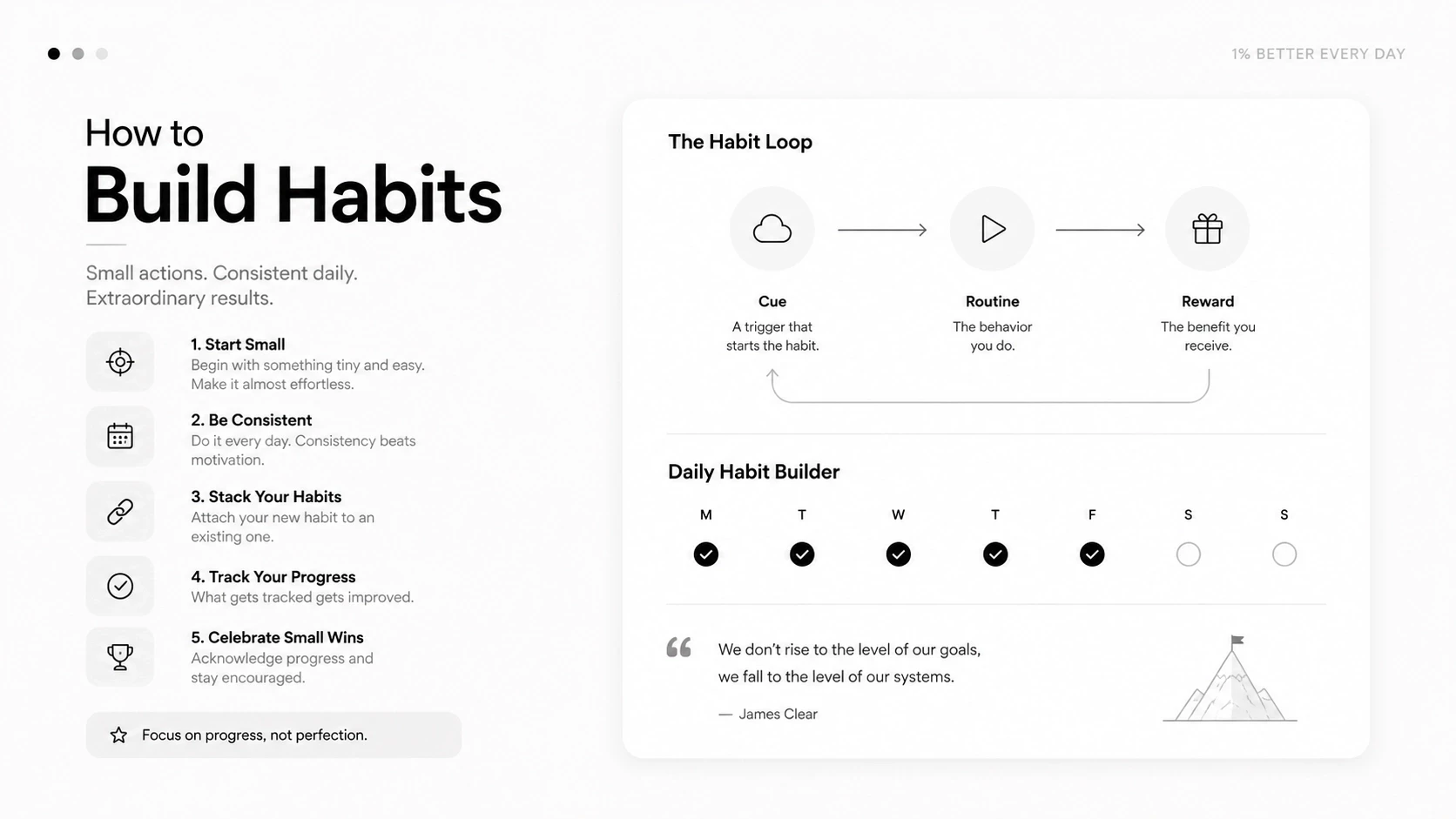
Habits usually break down for unglamorous reasons: the goal was too big, the cue was unclear, or there was no way to see progress. The fix is not more motivation. It is a smaller starting point, an obvious trigger, and one place to log what you actually did — and you can set that up in an afternoon.
Why most habits fall apart in week two
The first week runs on novelty. The second week runs on your system. If the only thing holding a habit up is how motivated you felt on Sunday night, it collapses the first time you are tired, busy, or travelling.
Three failure patterns show up again and again:
The habit is too big to do on a bad day.
Nothing in your environment reminds you to start.
You keep no record, so a five-day streak feels the same as a five-day gap.
The four laws of behaviour change, in plain English
James Clear’s Atomic Habits reduces habit formation to a loop — cue, craving, response, reward — and gives you one lever for each stage.
1. Make it obvious
Attach the new habit to something you already do without thinking. “After I pour my coffee, I write three lines” beats “journal more”, because the cue already exists in your day. Then put the object in your way: book on the pillow, shoes by the door, tracker open on your desktop.
2. Make it attractive
Pair the habit with something you look forward to. Podcast only while walking. Favourite playlist only while tidying. The habit borrows the appeal of whatever sits next to it.
3. Make it easy
Shrink it until it feels almost too small: two minutes of reading, one set of push-ups, opening the budget rather than balancing it. You are not training the outcome yet — you are training the act of showing up, and that is the part that has to become automatic.
4. Make it satisfying
Give yourself immediate evidence that it happened. A checkbox, a streak counter, a line on a tracker. Long-term rewards are too far away to steer daily behaviour. A visible mark today is not.
The two-minute rule does most of the work
Take the habit you want and cut it down to a version that takes two minutes. “Read before bed” becomes “read one page”. “Do yoga” becomes “unroll the mat”. It feels like cheating, and that is the point: a habit you can keep on your worst day is a habit that survives to become a big one.
On good days you will naturally do more. On bad days the two-minute version keeps the streak — and the identity — intact.
How to track habits without it becoming another chore
Pick three habits, maximum. More than that and the tracker becomes the thing you are avoiding.
Write the cue, not just the habit. “10 min walk” is vague. “10 min walk after lunch” tells you when to start.
Check in once a day, at a fixed time. Evening works well — you are reviewing, not planning.
Review weekly, not daily. One day tells you nothing. Seven days tells you whether the cue is working.
Never miss twice. One miss is an accident. Two in a row is the start of a different habit.
If you would rather not build the system from scratch, our Life Planner keeps habits, goals and daily plans in one Notion workspace, and the Productivity Vault layers weekly planning and streaks on top.
Common questions
How long does it actually take to build a habit?
There is no single number. The popular “21 days” figure traces back to a 1960s observation about surgical patients adjusting to their appearance, not to habit research. A University College London study published in 2010 found a median of about 66 days for a behaviour to feel automatic, with individual results ranging from 18 to 254 days. Plan in months, not weeks.
What should I do if I miss a day?
Do the two-minute version the next day, even if it feels pointless. The goal is to protect the pattern, not the performance.
How many habits should I start at once?
One if it is genuinely hard. Up to three if they are small and share a cue — for example, everything that happens right after breakfast.
Do I need an app to track habits?
No. Paper works. What you need is one place you will genuinely look at every day, whether that is a notebook, a wall calendar or a Notion dashboard.
Start with one habit this week
Pick a single habit. Shrink it to two minutes. Attach it to something you already do. Log it somewhere you will see tomorrow. Everything else — the apps, the charts, the colour coding — is decoration on top of those four moves.